
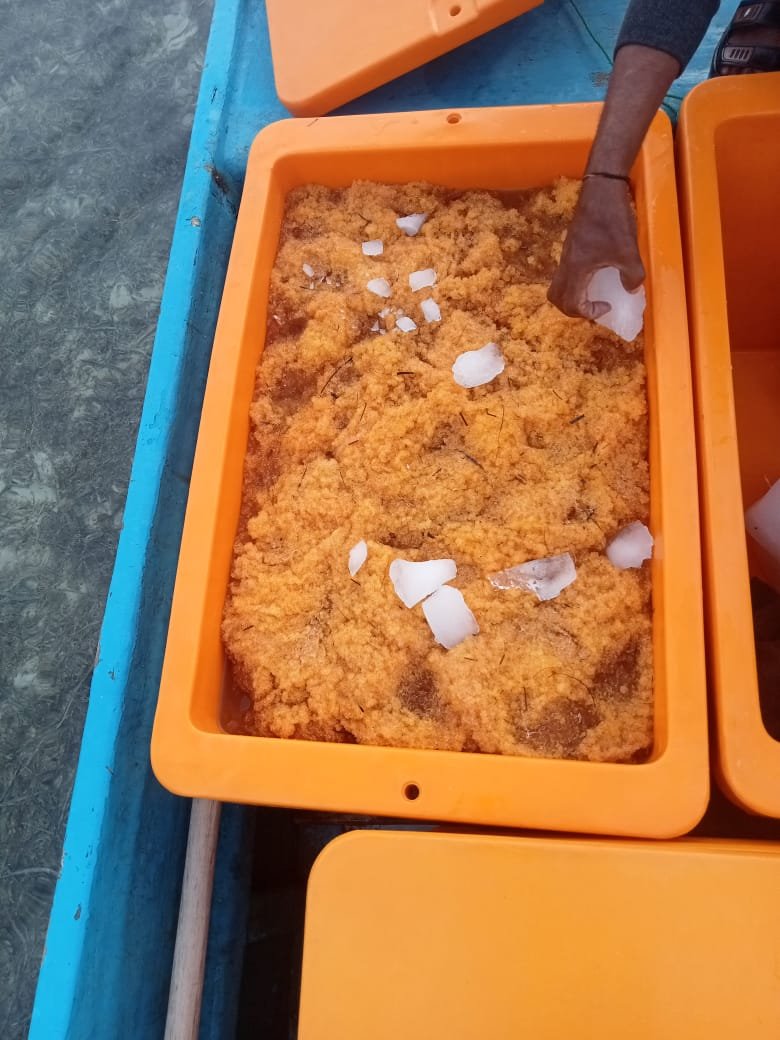
Product intelligence / Flying Fish Roe
Understand the fishery.
Define the ingredient.
The technical story starts at egg collection and continues through separation, processing and the intended use of the finished product.
Documented regional fisheries
A 2008 Indonesian fisheries study connects flying-fish-roe fisheries with the Makassar Strait and waters around Fakfak in West Papua. It identifies Hirundichthys oxycephalus as a principal exploited species in that regional context. Species and origin still require confirmation for each offered lot.
KKP BAWAL: flying-fish fishery context (2008 study) ↗Egg-collection structures
KKP describes wood or bamboo frames with coconut leaves used in the egg fishery, with local names including bale-bale, rumpon and pakkaja. These structures provide collection context; they do not establish the capture method of Ocean Pearl's offered material.
KKP: review of flying-fish fisheries management ↗Management questions matter
KKP discusses risks from excessive egg harvesting and discarded collection materials. The collection method alone is not evidence of sustainability. Ask about the actual fishery, management requirements and material recovery practices.
KKP: review of flying-fish fisheries management ↗Processing and handling brief
Separate the raw material from the finished product.
- 01
Collect
Record fishery area, collection method and harvest or landing information.
- 02
Separate
Specify removal of membranes, fibers and foreign material, with egg integrity criteria.
- 03
Define form
Confirm fresh, frozen, dried or salted condition and the handling route.
- 04
Process
Declare salt, colours, flavours, preservatives and any validated treatment.
- 05
Verify use
Distinguish an ingredient for further processing from a validated ready-to-eat product.
- 06
Pack & release
Agree packing, temperatures, lot documentation and destination requirements.
Buyer specification checkpoints, not a validated production recipe or a claim that every Ocean Pearl lot follows this route. Time, temperature, treatment, drying and storage controls must be established for the actual process, intended use and destination. Codex CXC 52-2003 and FDA seafood hazard guidance provide broader technical context, not product certification.
Compare offers on the same basis
Turn detail into
a measurable brief.
Identity
Species, harvest region and processing locationA shipment port is not necessarily a harvest area.
Physical condition
Egg integrity, size mix, fibers and foreign matterUse representative samples and agreed acceptance criteria.
Ingredients
Salt, colours, flavours and preservativesUnseasoned ingredient roe and finished tobiko need different specifications.
Intended use
Further processing or ready-to-eatReady-to-eat suitability needs product-specific validation, not a product name.
Documented Indonesian context
Place the research
on the map.
Published fishery and processing locations, shown as approximate regional references. This is an educational map, not Ocean Pearl sourcing coverage, current stock or shipment routes.
Makassar Strait
The Makassar Strait is documented in Indonesian flying-fish and roe-fishery research. The regional reference comes from a 2008 study, not a current stock or season forecast. Exact harvest area and collection method belong in lot documentation.
Read the source ↗Fakfak / West Papua
Waters around Fakfak in West Papua are documented in the same 2008 flying-fish study. The map marks broad regional context, not an Ocean Pearl supplier, landing point or processing establishment.
Read the source ↗Map: existing Natural Earth geographic base, reused from Ocean Pearl's site. Natural Earth terms. Shaded regions are illustrative geographic anchors, not surveyed boundaries. Study dates and evidence types are stated above.
Read the evidence
Sources behind
the guide.
Research findings and technical guidance are kept separate from lot-specific commercial claims. Buyer checkpoints are Ocean Pearl's editorial synthesis.