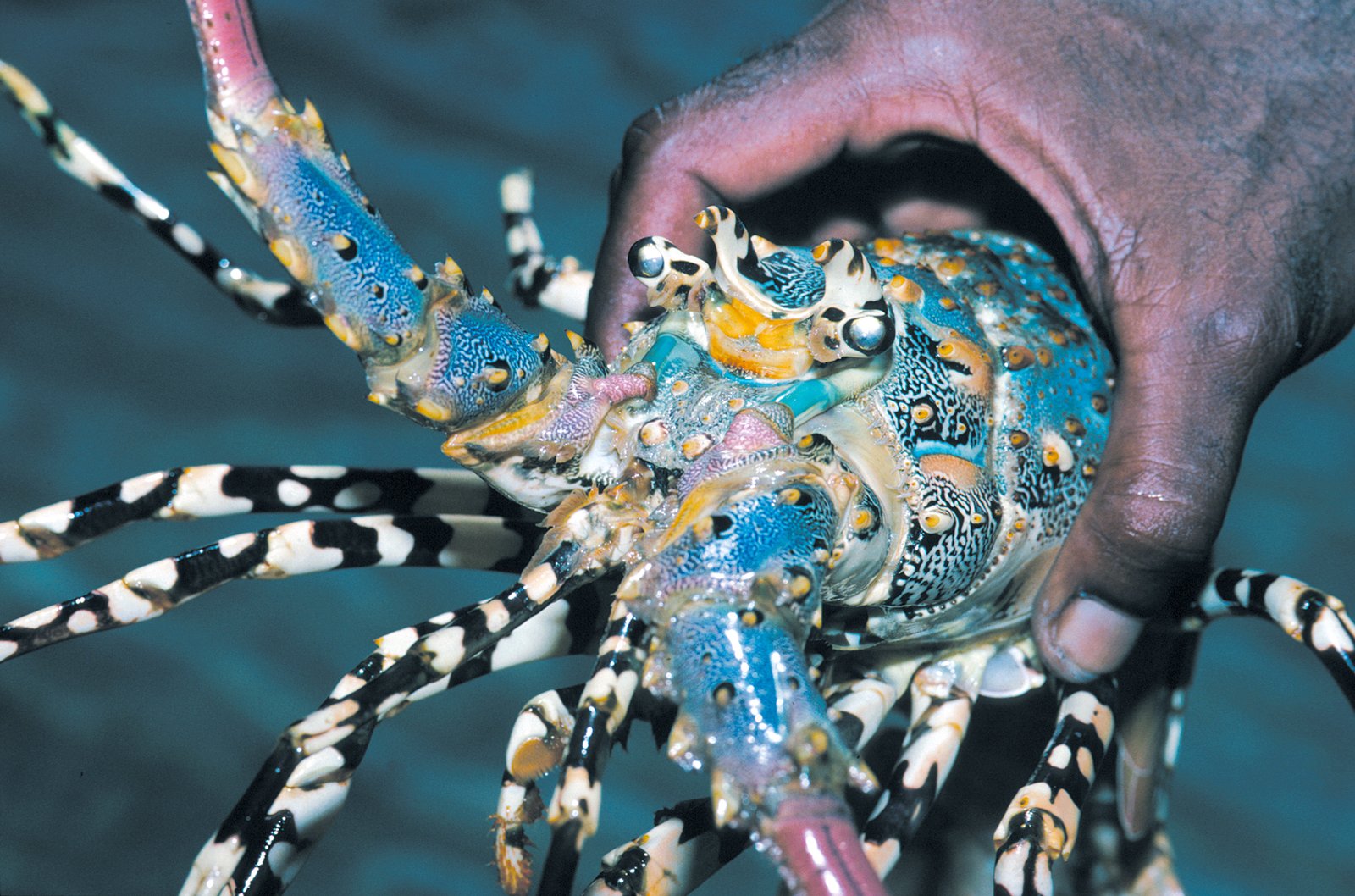
Panulirus ornatus Ornate spiny lobster · Reference specimen Photo: CSIRO, ScienceImage 3341, via Wikimedia Commons · CC BY 3.0Photo & source details →
Two lobster families Spiny & slipperReal photography Clear, above-water viewsReference, then confirmation Species and supply checked for the offered lot
The details make the difference
Find the name. See the difference.
Bambu, Mutiara, Batik, Pasir and Kipas are useful market names. Scientific identification brings the specification into focus. Start with the two families, then look more closely at the species.
Each image shows a real reference specimen. Local names can overlap; the notes explain where identification needs extra care. These are species references, not current stock offers.
10 photographic references
spiny lobster01 / Reference
Bambu
Panulirus versicolor
Painted spiny lobster
Bold pale abdominal bands bordered by dark lines give this species its distinctive painted appearance.
Usual Indonesian trade-name association. Confirm the offered specimen.
Identification notes & sources
Look for broad pale transverse abdominal bands with dark borders and blue-white longitudinal leg stripes. The smooth abdominal segments lack transverse grooves.
Real above-water specimen photographed on exposed coastal rock.
Mahomed Desai, via iNaturalist / Wikimedia Commons. Source · CC BY 4.0. Unaltered reference photograph.
spiny lobster02 / Reference
Batik · longipes
Panulirus longipes
Longlegged spiny lobster
A spotted spiny lobster with distinct pale dots on the abdomen and long, slender legs.
Batik is shared with P. femoristriga. Confirm identity from diagnostic details.
Identification notes & sources
Transverse abdominal grooves and distinct pale round spots help characterize this group. Striped legs alone do not distinguish it from P. femoristriga; inspect the fine antennular flagella.
Taxon-labelled IFREMER reference specimen on white, photographed above water. Not Ocean Pearl stock.
Melodie Chapat / IFREMER, via Wikimedia Commons. Source · CC BY 4.0. Unaltered reference photograph.
spiny lobster03 / Reference
Batik · femoristriga
Panulirus femoristriga
White-whiskered rock lobster
A spotted, strongly striped species distinguished by its white inner antennular flagella.
Also associated with Batik or Batik Merah. A trade label alone cannot separate it from P. longipes.
Identification notes & sources
The thin inner antennular flagellum is entirely white. Do not confuse the fine antennules with the much larger main antennae. The cited modern study combines morphology and COI evidence.
Above-water dried museum display behind glass. Preserved colour differs from live product.
A. C. Tatarinov, via Wikimedia Commons. Source · CC BY-SA 3.0. Unaltered reference photograph.
spiny lobster07 / Reference
Pasir
Panulirus homarus
Scalloped spiny lobster
Fine pale spots and scalloped abdominal grooves characterize the scalloped spiny lobster.
Usual Indonesian trade-name association. Confirm fine features in close photographs.
Identification notes & sources
Inspect the scalloped front margins of the abdominal transverse grooves and four separate principal spines on the antennular plate. The scalloping can be subtle.
Museum-vouchered reference MNHN-IU-2010-5068. The source filename uses an older genus combination.
Chan T.Y. & Lin C.W. / MNHN, specimen MNHN-IU-2010-5068, via Wikimedia Commons. Source · CC BY 4.0. Unaltered reference photograph.
slipper lobster10 / Reference
Kipas Merah · Aesop
Scyllarides haanii
Aesop slipper lobster
A robust slipper lobster distinguished from S. squammosus by the strong hump on the fourth abdominal segment in adults. A lateral photograph is especially useful.
Merah is an overlapping market name. Confirm S. haanii versus S. squammosus from the actual specimen.
Identification notes & sources
Adult Scyllarides haanii has a conspicuous median hump on the fourth abdominal segment. Compare the whole carapace and abdominal relief, including a side view, with the published identification key. Colour alone does not distinguish the species.
Historical dried museum specimens; preserved colour differs from live product. This image is a taxonomic reference, not current stock photography.
Naturalis Biodiversity Center · RMNH.CRUS.D.5520. Source · CC0 1.0. Unaltered reference photograph.
What a photograph can tell you
Specimen photographs help explain identity. They do not establish Ocean Pearl stock, catch location, condition, size grade or legal export eligibility. Confirm those details with the actual lot.
Beyond the pictured species
Kipas: the wider picture.
Additional documented species
Thenus indicus
Documented from southern Java and Kupang. Thenus contains several distinct species, so a generic Kipas or Thenus label needs specimen-level confirmation. We do not assign this species to Tanduk or Hitam, or imply current supply.
The cited Indonesian field report leaves this trade name without a confirmed scientific identity. There is no substitute species photograph here: a labelled specimen and reliable identification are needed first.
A precise buying brief connects the local name, the scientific name and the offered specimen. Colour alone is not enough.
Request the right views.Ask for a full dorsal view, side profile, underside, close view of the antenna bases and fine antennules, plus a scale and actual weight. Keep the lot or supplier code with every image.
Batik needs a closer look
Panulirus longipes and Panulirus femoristriga can both be called Batik. The fine inner antennular flagellum is a useful distinguishing character; a general body photograph or striped legs alone may not resolve them.
Kipas Merah is not a unique species
The name has been associated with both Scyllarides haanii and Scyllarides squammosus. A side view helps reveal the prominent fourth-abdominal-segment hump in adult S. haanii. Red colour is not a sufficient identification.
Kipas Tanduk remains unresolved
Published Indonesian field work records this trade name without a confirmed scientific identity. We do not attach a Latin name or substitute photograph to it. Obtain a clearly labelled specimen series before specifying it.
Pakistan is a trade name, not an origin
In the Indonesian trade-name context, Pakistan is commonly linked to Panulirus polyphagus. The name does not establish the country where the offered lobster was caught.
From reference to requirement
A better brief. A clearer conversation.
Agree the product and evidence before comparing quotations. Availability, preparation and shipment requirements are confirmed for each proposed lot.
01 / IDENTITY
Species & origin
Scientific name, supplier or lot code, harvest location, traceability records and recent labelled specimen photographs.
02 / FORMAT
Form & condition
Whole, tail or prepared form; live, chilled or frozen condition; raw or cooked status. Confirm the offered format rather than assuming availability.
03 / GRADING
Size & net weight
Weight per piece or count per kilogram, grading stage, acceptable range, declared net weight and glaze where relevant.
04 / DELIVERY
Packing & destination
Inner and outer pack, labels, quantity, destination, shipment window and applicable harvest, health and import requirements.
Current legal requirements, minimum sizes, protected conditions, export permissions and destination rules must be checked for the actual species and transaction. This page is an identification and buying reference, not a legal clearance or production protocol.
Talk to Ocean Pearl
Let's define your requirement.
Share the species or local name you use, your preferred form and your destination. We can start with a clear brief and confirm the proposed product details.
No. The collection uses attributed reference specimens to explain species. A photograph's credit identifies its source. Ask for recent photographs of the actual offered lot before proceeding.
Does every Kipas name identify one species?
No. Kipas describes a broad slipper-lobster group in trade. Names such as Merah can cover alternatives, and Tanduk remains unresolved in the cited field source. The scientific identity must be confirmed separately.
Can I order every species and format shown?
The page is a reference collection, not a stock list. Current availability, size, format, origin, documents and commercial terms require a separate offer. No order is placed through this page.
Is this a complete list of Indonesian lobster species?
No. It focuses on the market names and species relevant to this guide, including additional slipper-lobster references. It is not a national biodiversity inventory or a guarantee that all these species occur in one sourcing area.
Evidence behind the detail
Sources & image credits.
Scientific references support the identification notes. Image sources, authors and licences appear beside the corresponding photographs. Reviewed 7 November 2026.